
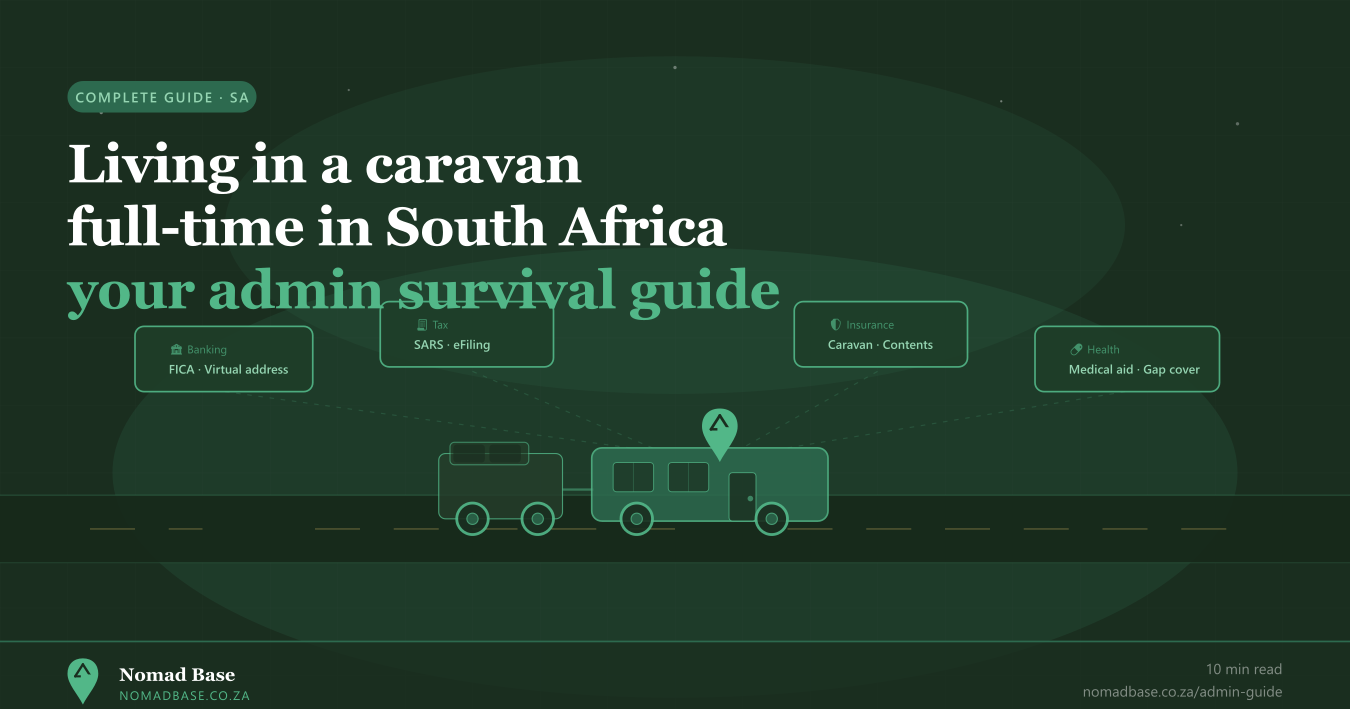
More South Africans are choosing to live in a caravan or at a campsite for long periods, whether from cost pressure, work flexibility, or deliberate lifestyle design.
The lifestyle is possible, but the admin side needs to be handled carefully because many South African systems still separate residential address, postal address, and contact details.
Is it legal to live in a caravan full-time in South Africa?
There is no single national law that says a person may not live in a caravan full-time. In practice, the bigger issue is not your personal legality as a resident, but whether the land, campsite, resort, farm, or property is allowed under zoning, municipal rules, lease terms, or park rules to host long-term occupation. That makes this partly a property-use and contract question, not just a “yes or no” personal law question.
So the safer way to say it is this: living in a caravan is not automatically unlawful, but long-term occupation must still fit the rules of the place where you stay. Before settling anywhere for months, get written clarity from the operator or landowner on length of stay, use of the stand, utilities, post, and whether they will give you a residency letter if needed.
The most important correction: do not rely on a virtual address as your main fix
A virtual address can be useful as a mailing or correspondence address. It may help with receiving letters, parcels, and certain non-residential contact records, but it should not be treated as your automatic answer for SARS, banks, traffic licensing, or other government-facing systems that ask for a physical residential address.
SARS says proof of address must reflect the taxpayer’s name and physical address, and it also provides a CRA01 third-party confirmation form for residential or business address where standard proof is difficult. The transport system similarly requires proof of residential and postal address for eNaTIS-related records, which shows clearly that these are separate address concepts in South African admin.
That means a permanent camper should usually think in terms of three address layers, not one. Your first layer is your actual place of stay, your second is your reliable postal or correspondence address, and your third is your documentary proof chain showing why your situation does not look like a normal utility-bill household.
What works better than “just get a virtual address”
The stronger approach is to build an address file. This usually means keeping copies of your ID, a campsite or landowner letter confirming that you stay there, any signed occupancy or long-stay agreement, an affidavit explaining your living arrangement where needed, and a separate mailing or correspondence address for post.
That does not guarantee every institution will accept every document the first time. What it does do is give you a lawful and consistent paper trail that matches how South African systems actually work.
Banking
Banking is one of the areas where the original wording needed the most correction. South African banks generally still require proof of residential address for FICA purposes, and official bank guidance refers to documents showing your name and physical or residential address.
That means you should not assume a virtual office letter will be accepted as your residential proof. Some banks may consider alternative supporting documents or declarations in unusual cases, but the rule on paper is still tied to residential address verification, so success often depends on the exact facts and the documents you bring.
For a permanent camper, the practical route is to keep your banking profile aligned with a real, documentable residential location where possible. That could be a campsite with a written occupancy letter, a property where you genuinely stay and can be confirmed by the account holder, or another lawful living arrangement backed by an affidavit and supporting documents.
SARS and tax
SARS is more precise than the earlier version suggested. It allows you to update registered details through eFiling, and SARS correspondence is increasingly available electronically, but SARS still distinguishes between admin convenience and proof requirements. Its published guidance says proof of residential or business address must show the taxpayer’s name and physical address.
So the correct advice is not “SARS accepts virtual addresses” as a blanket rule. The better advice is that you should keep your SARS registered details current, use eFiling for notices and updates, and be ready to support your residential address with acceptable proof or, where applicable, a third-party confirmation form such as CRA01.
Insurance
Insurance remains a high-risk area, and that part of the original text was right in principle. If the caravan is your main dwelling, that fact must be disclosed clearly to the insurer in writing because ordinary leisure-use assumptions may not fit a permanent living setup.
The missing point is that address disclosure matters here too. Your insurer may care not only that the caravan is lived in permanently, but also where it is mainly kept, how often it moves, what security exists on site, and whether contents cover and liability cover are structured for residence rather than occasional holiday use.
Medical aid
The original version was too broad. It is safer to say that medical schemes and administrators often still ask for both a physical address and a postal or correspondence address, rather than saying a fixed address is not needed at all. One major scheme’s application material explicitly refers to physical and postal address details.
For permanent campers, the practical issue is less about “being allowed” to join and more about keeping contact, claims, delivery, chronic medication, and emergency records accurate. In other words, your admin must be portable even if your living setup is mobile.
Vehicle licensing and traffic records
Traffic administration also needed correction. Government transport communication around eNaTIS verification specifically refers to proof of residential and postal address, so this is another area where a virtual address alone should not be treated as the answer.
Online systems can help with renewals and appointments, but that convenience does not remove the underlying requirement to keep identity and address particulars correct. Keep your licence renewal dates, vehicle registration records, and any proof-of-address support documents together in one digital and printed file.
SASSA and pensions
The earlier text was too casual here as well. The safest advice is to keep SASSA or pension contact details and banking details updated directly through the relevant official channel, because payment and identity records matter more than whether you receive post at one place permanently. SASSA provides official routes for changing banking details and contact details for relevant grants.
This does not mean address never matters. It means beneficiaries should prioritise correct banking, identity, phone, and official contact records instead of assuming a mailing workaround will solve everything.
1. Secure a lawful place-to-stay paper trail
Get a written long-stay or occupancy letter from the campsite, farm, resort, or landowner. If possible, make sure it includes your name, ID number, stand number or site description, start date, and contact details for the operator.
2. Separate residential and correspondence addresses
Use a correspondence address only for correspondence. Do not present a mailing address as your residential address unless it is in fact where you live and can be supported lawfully.
3. Build an address evidence pack
Keep your ID, affidavit, occupancy letter, any lease or stand agreement, and any third-party confirmations together in cloud storage and as printed copies. SARS and banks both publish address-related requirements that may need supporting documents.
4. Update SARS and enable digital correspondence
Use eFiling to keep registered details current and rely on the SARS online correspondence centre so you are not dependent on paper mail.
5. Regularise your banking records
Ask your bank exactly what it will accept for your residential proof in your circumstances. Do not assume one branch, one forum post, or one virtual-address provider reflects the actual policy.
6. Notify your insurer in writing
Confirm that the caravan is used as a main dwelling, and ask the insurer to confirm cover in writing. Keep the schedule and confirmation email saved offline as well as online.
7. Review medical aid and delivery logistics
Make sure the scheme has the right physical and postal details, plus current phone and email contacts. If you move often, also plan how medicine, cards, and documents will reach you.
8. Keep transport and grant records current
Use official channels for NaTIS-related services, SASSA contact changes, and banking updates. Do not leave these until an expiry date or payment problem forces action.
FAQ
Q: Should permanent campers in South Africa get a virtual address?
A: A virtual address can help for mail and general correspondence, but it should be treated as a support tool, not the foundation of your whole admin system. Many institutions still want proof of a real physical residential address.
Q: What matters more than a virtual address?
A: A consistent documentary trail. That usually means a real occupancy letter, affidavit where needed, correctly separated residential and postal details, and updated digital records with SARS, your bank, and other institutions.
Q: Can I simply use one address for everything?
A: Often no. South African systems commonly distinguish between residential, business, and postal addresses, so using one address for every purpose can create problems if that address is only a mailing service
Download the No-Address Starter Pack